The Condition of our Beaches
With all the negativity in the press and on social media, it being peddled by political actors that benefit from bad news, you would think that our beaches are the worst they have ever been. This is completely false.
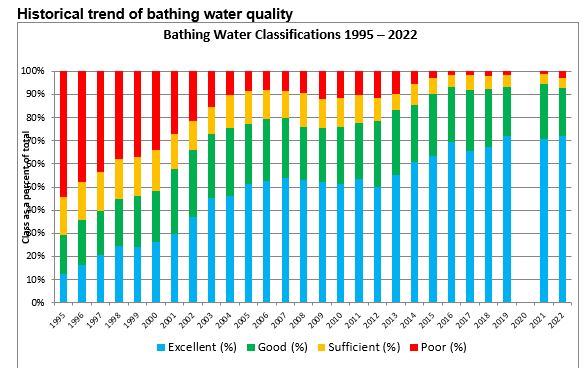
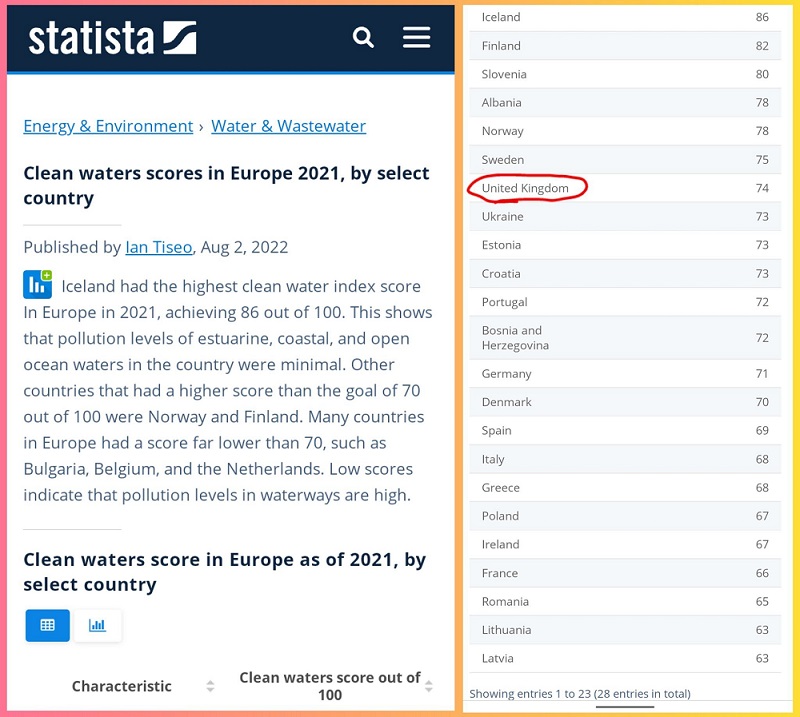
For the first time this year, in 2022, 100% of the classified bathing waters in the South West have passed their stringent standards, with 98% rated as or ‘Good’ or ‘Excellent’, compared to c.28% in 1991. These are the tighter standards introduced by Government under the 2006 EU directive, which came into effect in 2015. We do not have the worst waters in Europe as many people may claim: See below picture with water quality ratings for many European Countries and historical bathing water classifications:
The Condition of our Rivers
Almost 80% of individual tests across all water bodies meet the threshold for Good Ecological Status (GES), but a water body must achieve the required standard for GES for every underlying assessment in order to achieve GES overall. Failure of one individual test means that overall the water body will fail to reach GES. This concept is known as ‘one-out-all-out' (which is why only 16% of surface water bodies in England currently meet good ecological status).
We have delivered an 80% reduction in phosphorus concentrations since 1990. Levels of ammonia, which is toxic to aquatic life including fish, have reduced to just 15% of their levels in 1990. Iconic species, such as seahorses, seals and salmon, are returning to our rivers and estuaries. Salmon have returned to the River Donn for the first time in 200 years.
Our bathing waters have been steadily improving over time, with 93% of the bathing waters in England at ‘good’ or ‘excellent’ in the latest classifications. Those bathing waters meeting the highest standard, ‘excellent’, has risen to 72%, the highest level since new standards were introduced in 2015.
The European Environment Agency’s data shows that that it will be very challenging for most EU Member States to achieve good ecological status for all water bodies in the time frame of the Water Framework Directive. England’s performance is comparable with equivalent Northern European countries on water quality, bathing water and urban wastewater treatment directive compliance.
Questions
Why have you pushed back the legal deadline to meet your water targets to 2063?
There have been inaccurate claims in the media that the target for good ecological status for rivers has been moved back to 2063. This is categorically not true. We have not amended the Water Framework Directive (where this target comes from) in any way, as this is part of the process set out by the regulations.
The 2063 date comes from modelling undertaken by the Environment Agency for a specific group of three chemical pollutants. These three specific chemical pollutants are a type of Ubiquitous, Persistent, Bio cumulative, Toxic (uPBT) substances.
These chemicals are already banned, but modelling by the EA shows that it will take until 2063 for the legacy pollution to dissipate from the water environment. They were previously used all over the world in fire retardant, non-stick and water repellent commercial products. 97% of all surface water bodies in England would be at Good Chemical Status were it not for the presence of these substances.
What about SAS Reports of Dry Discharges?
South West Water Spokesperson: “We have been working hard to reduce the impact of storm overflows and in this year’s bathing season we have reduced spills by 50% on last year, with a 75% reduction in duration, across our 860 miles of coastline. However, we recognise there is more to do.
Our largest environmental investment programme in 15 years, WaterFit, is well underway, focused on delivering benefits for customers, communities and the environment. This year, for the first time, 100% of the classified bathing waters in the South West passed stringent standards, with 98% rated as or ‘Good’ or ‘Excellent’, compared to c.28% in 1991 and we are delivering improvements to maintain and further improve our region’s excellent bathing water quality all year round.”
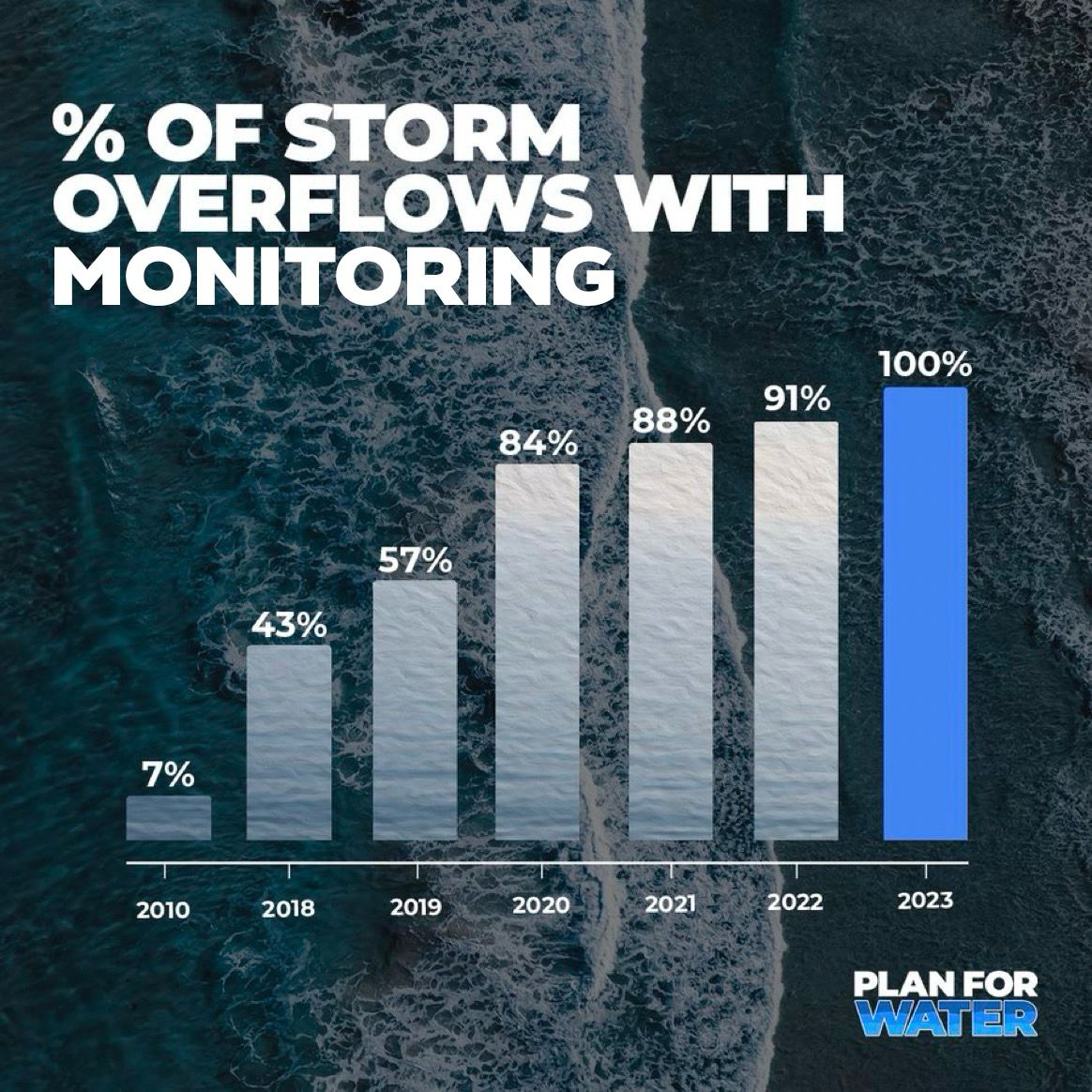
% of Storm Overflows Monitored under the Conservatives